
Choosing the right timing machine can make mechanical-watch diagnosis and regulation faster, more consistent, and easier to document. The models in this roundup focus on accessible tools for watchmakers, repair benches, and small workshops.
We compare multifunctional timegraphers, LCD-equipped testers, and options that add battery or demagnetization functions, helping you match features to your daily workload without paying for capabilities you will not use.
Best 10 Watch Timing Machines for Small Workshops Picks for 2026
Precision Bench Choice

- ±0.1 seconds/day claimed accuracy
- Displays key mechanical movement metrics
- Tests six positions and supports adjustable sampling
Best For: Mechanical-watch workshops needing detailed diagnostics
Compact Multi-Function Pick

- Tests quartz movements and batteries
- Includes pulse testing and demagnetization
- Compact battery-powered design
Best For: Small mixed-watch repair benches
Simple Mechanical Tester

- Multifunctional watch tester
- Designed for mechanical-watch calibration
- Exact specifications should be verified
Best For: General mechanical timing work
Entry Bench Timegrapher
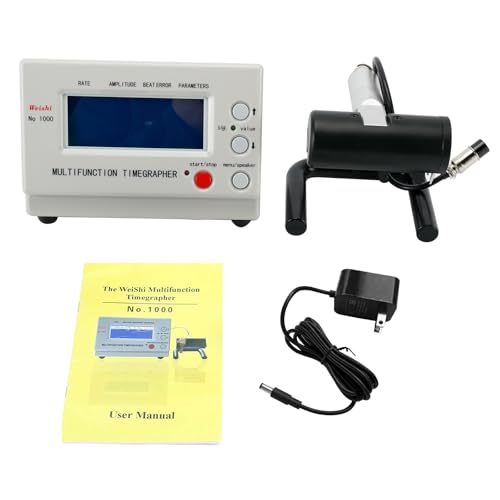
- Listed as a multifunction timegrapher
- Designed for watch timing tests
- Technical specifications are limited
Best For: Buyers seeking a basic workshop tester
Best All-Around Choice

- Large LCD shows key timing readings
- Works with mechanical and coaxial watches
- Easy setup with one-year warranty
Best For: Collectors, hobbyists, and small professional workshops
Simple Workshop Tool

- Dedicated multifunction watch tester
- Potential fit for a compact workshop bench
- Verify compatibility and included items first
Best For: Buyers seeking a basic timing tool
High-Resolution Upgrade

- Large high-resolution color screen
- Reports rate, amplitude, beat error, and more
- Includes sensor, adapter, and manual
Best For: Mechanical-watch makers and technicians
Easy-Start Pick
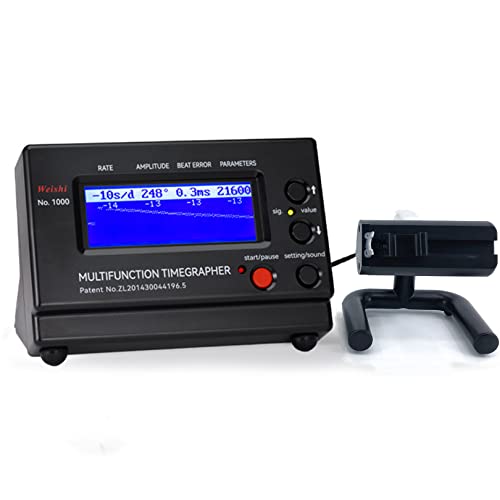
- Live rate, amplitude, beat error, beat, and lift angle readings
- Automatic signal adjustment for different watches
- Suitable for hobbyists, collectors, and professional use
Best For: Straightforward routine testing of mechanical watches
Diagnostic Upgrade

- Color traces distinguish entrance and exit pings
- Measures rate, amplitude, beat error, beat, and lift angle
- Supports one to six positions and AC 100V–240V
Best For: Troubleshooting and adjustment work requiring clearer traces
Precision Bench Tool
Multifunctional No.1000 Tester
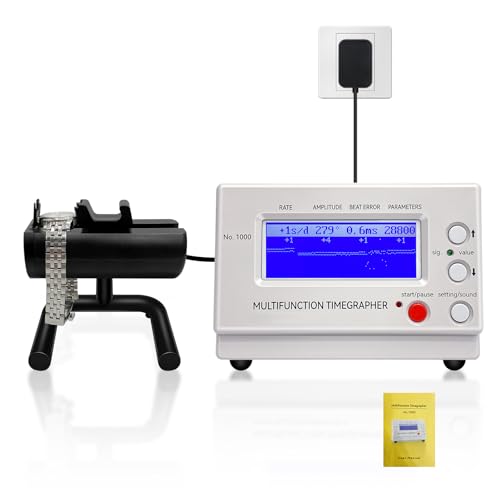
- Tests rate, amplitude, polarity, beat, lift angle, and period
- Provides 0.1 sec/day resolution and adjustable sampling
- Compact, portable design with 100V–240V input
Best For: Detailed movement diagnosis and calibration on compact benches
Precision Bench Choice – SWANSOFT No.1000 Timegrapher
For small workshops seeking watch timing machines for small workshops, the SWANSOFT No.1000 is a feature-rich choice for diagnosing and calibrating mechanical movements. It displays rate, amplitude, beat error, lift angle, and timing curves, while supporting six testing positions.
Best For: Watchmakers and repair technicians working primarily on mechanical watches, including special, antique, or faulty movements.
Pros:
- Claims ±0.1 seconds/day accuracy with a 50-sample average.
- Measures rate, amplitude, beat error, and lift angle with live graphs.
- Supports 2–60-second sampling cycles and six positions.
- Includes a 12-month satisfaction guarantee and support.
Cons:
- For mechanical movements only; it does not support quartz watches.
- Its advanced features may be more than a basic repair bench requires.
This is the strongest option here for detailed mechanical-watch analysis, particularly when a workshop needs broad measurement coverage and adjustable testing.
Compact Multi-Function Pick – Quartz and Battery Tester
Among watch timing machines for small workshops, this compact tester is aimed at routine bench checks rather than detailed mechanical calibration. It combines quartz testing, battery-capacity testing, pulse testing, and adjustable-speed demagnetization in a battery-powered unit.
Best For: Small repair benches that service both quartz and mechanical watches and need basic battery, pulse, and demagnetization functions.
Pros:
- Combines quartz testing, battery testing, pulse testing, and demagnetization.
- Adjustable demagnetization speed adds flexibility.
- Compact, lightweight, and powered by two AA batteries.
- Can test battery capacity without opening the watch case using pulse testing.
Cons:
- It is not described as a detailed mechanical timegrapher for rate, amplitude, or beat-error analysis.
- Two AA batteries are required and are not included.
- The supplied specifications provide limited information about measurement precision.
This model makes sense when versatility and portability matter more than advanced mechanical-movement diagnostics.
Simple Mechanical Tester – No.1000 Watch Timegrapher
This No.1000 watch timegrapher is a straightforward candidate for workshops comparing watch timing machines for small workshops. Its listing identifies it as a multifunctional tester and calibration tool for mechanical watches, making it relevant for routine mechanical-movement work.
Best For: Watchmakers looking for a No.1000-style mechanical watch tester for general timing and calibration tasks.
Pros:
- Designed as a multifunctional watch tester.
- Intended for mechanical-watch calibration.
- Uses a familiar No.1000 timegrapher format for workshop applications.
Cons:
- The supplied product notes do not specify accuracy, supported positions, or displayed measurements.
- There is no supplied information about quartz-watch compatibility.
Consider this option when the product price and available listing details are favorable, but verify its exact specifications before relying on it for precision diagnostics.
Entry Bench Timegrapher – Multifunction No.1000 Tester
For buyers comparing watch timing machines for small workshops, this multifunction No.1000 tester is a basic option to investigate for watch timing work. The supplied listing identifies it as a watch timing machine tester, but provides few technical details for comparing measurement capability.
Best For: Small workshops seeking a basic multifunction timegrapher and willing to confirm specifications before purchase.
Pros:
- Listed as a multifunction timegrapher.
- Designed specifically for watch timing-machine testing.
- No.1000-style designation may suit buyers comparing familiar bench formats.
Cons:
- The supplied notes do not state accuracy, movement compatibility, or measurement ranges.
- Features such as positions, sampling cycles, and display metrics are not provided.
- Its capabilities cannot be directly compared with more fully specified models from the supplied information.
This is best treated as a specification-checking purchase: confirm the supported movements and measurement functions before adding it to a professional calibration bench.
Best All-Around Choice – No.1900 LCD Timegrapher
For small workshops seeking watch timing machines for small workshops, the No.1900 offers a straightforward way to check mechanical watch performance. Its larger LCD displays live rate, amplitude, beat error, beat, and lift angle readings, and it is designed for easy setup.
Best For: Watch collectors, hobbyists, and small professional workshops testing mechanical and coaxial watches.
Pros:
- Larger LCD screen with live timing measurements
- Works with almost all mechanical watches, including coaxial watches
- Easy to use out of the box
- Includes a one-year warranty and customer support
Cons:
- Designed for mechanical watches rather than quartz models
- Requires AC power
The No.1900 is a practical pick when readable results and simple operation matter more than advanced workshop automation. Its broad mechanical-watch compatibility makes it a versatile addition to a compact bench.
Simple Workshop Tool – No.1000 Watch Timegrapher
The No.1000 is a basic watch timing machine for small workshops and watch users who need a dedicated watch tester. Because the supplied information provides no further specifications, confirm the listing details, included accessories, and supported movement types before buying.
Best For: Buyers looking for a straightforward watch-testing tool and willing to verify specifications before purchase.
Pros:
- Purpose-built as a multifunction watch tester and timing tool
- Suitable for adding timing capability to a small workshop
Cons:
- Available notes do not specify screen features or measurements
- Movement compatibility is not provided
- Included accessories and warranty information are not provided
This model may suit a budget-conscious bench, but the limited supplied detail makes it important to review the current product listing carefully before committing.
High-Resolution Upgrade – SWANSOFT No.1900 Timegrapher
The SWANSOFT No.1900 is a strong option among watch timing machines for small workshops when a larger, high-resolution display is useful. It shows live rate, amplitude, beat error, beat, and lift angle readings, while the backlit interface is intended to be easy to operate.
Best For: Watchmakers, technicians, collectors, and hobbyists testing mechanical or automatic watches.
Pros:
- Larger, high-resolution color LCD screen
- Displays multiple live timing measurements
- Includes sensor, US adapter, and professional user manual
- Includes a one-year warranty and customer service
Cons:
- Only suitable for mechanical movement watches
- Does not support quartz watches
- Requires corded power
With its readable display and included sensor, the SWANSOFT model is well suited to a dedicated watchmaking desk. Choose it when clear diagnostics for mechanical and automatic movements are the priority.
Easy-Start Pick – No.1000 Watch Timegrapher
KINSANINC Watch Tester Timegrapher No.1000, Watch Timing Machine Calabration for Mechanical Watches
Check Price On AmazonFor small workshops seeking straightforward watch timing machines for small workshops, the No.1000 offers an accessible way to check key mechanical-watch performance readings. Its digital LCD presents rate, amplitude, beat error, beat, and lift angle, and it is designed to work with nearly all mechanical watches, including coaxial models.
Best For: Collectors, hobbyists, and small workshops wanting an easy-to-use everyday tester.
Pros:
- Displays rate, amplitude, beat error, beat, and lift angle live.
- Automatically adjusts the optimal signal level for different watches.
- Works with almost all mechanical watches, including coaxial watches.
- Includes a one-year warranty and customer support.
Cons:
- Uses a monochrome-style digital display rather than a higher-resolution color screen.
- Its supplied features are focused on core testing rather than advanced trace diagnosis.
The No.1000 is a practical entry point when ease of operation matters most. It provides the essential measurements without adding a more complex interface, making it a sensible fit for routine checks at a compact bench.
Diagnostic Upgrade – No.1900 Color Timegrapher
The No.1900 is a stronger choice for small workshops that need clearer diagnostics from their watch timing machines for small workshops. Its larger color screen shows separate yellow and light-blue traces, helping users distinguish entrance and exit pings while adjusting beat error or investigating movement faults.
Best For: Watchmakers and serious hobbyists who need multi-position testing and clearer troubleshooting data.
Pros:
- High-resolution color display makes the traces easier to distinguish.
- Measures rate deviation, amplitude, beat error, beat number, and lift angle.
- Supports one to six measuring positions and mechanical and coaxial watches.
- Includes a sensor, US adapter, manual, and cleaning cloth.
Cons:
- Its expanded diagnostic features may be more than casual users need.
- The product notes specify an English display, which may not suit every user.
Compared with the No.1000, this model adds a more informative visual interface and trace separation. That makes it particularly useful when a workshop moves beyond simple performance checks into beat-error adjustment and fault diagnosis.
Precision Bench Tool – Multifunctional No.1000 Tester
For compact repair benches comparing watch timing machines for small workshops, this multifunctional tester emphasizes measurement range, sampling control, and portability. It checks daily rate, beat amplitude, polarity, beat, lift angle, and period, while supporting automatic standard-beat detection, manual special-beat selection, and one to six directional measurements.
Best For: Makers, technicians, and watch enthusiasts who want broader movement diagnostics in a portable unit.
Pros:
- Offers 0.1 sec/day rate resolution and a ±999 sec/day measurement range.
- Measures polarity, with 196 high-density sampling points for detecting abnormalities.
- Supports 2–60 second sampling periods and a 100°–360° amplitude range.
- Compact design, wide-voltage 100V–240V input, and a stable zinc-alloy microphone base.
Cons:
- The interface is described as analog-digital rather than a large color display.
- It is not water resistant, so it needs a protected workshop location.
- The listed warranty is 365 days.
This model is aimed at users who value detailed measurement capability over the simplest possible operation. Its portability and broad testing functions make it well suited to a small bench handling maintenance, calibration, and movement diagnosis.
How We Picked the Best Watch Timing Machines for Small Workshops
We focused on the functions that matter most at a compact repair bench: timing-rate measurement, beat error, amplitude readings, lift-angle support, positional testing, display clarity, and straightforward operation. We also considered whether a machine is practical for repeated testing, calibration work, troubleshooting, and basic customer demonstrations.
Because product listings can vary by seller and revision, verify the included accessories, supported specifications, power requirements, and return policy before ordering. A timing machine is a diagnostic aid, not a substitute for proper servicing or a calibrated reference standard.
Quick Comparison
| Type | Best For | What to Check |
|---|---|---|
| No.1000 timegrapher | Routine regulation and diagnosis | Readability, microphone stability, and available measurements |
| No.1900 timegrapher | Users who prefer a larger or clearer LCD interface | Screen layout, positional modes, and included accessories |
| Multifunction tester | Benches handling varied testing tasks | Whether battery or demagnetization features are genuinely useful |
Key Buying Factors for Watch Timing Machines for Small Workshops
Measurements and Positional Testing
At minimum, look for rate, amplitude, and beat error readings. Multiple positions are valuable because a movement may perform well dial-up but poorly in other orientations. Confirm that the machine supports the lift angle required by the movements you service, or that the setting can be adjusted manually.
Display and Usability
A clear screen, stable audio pickup, simple controls, and a readable trace reduce setup time. If several technicians share the bench, intuitive operation matters more than a long feature list. A stable watch holder and reliable microphone connection are also essential for repeatable results.
Build, Connectivity, and Support
Check the enclosure, power arrangement, cable quality, replacement-part availability, and warranty terms. Compact equipment is convenient, but it should still sit securely while a watch is being tested. Look for clear instructions and a seller willing to answer technical questions.
Extra Functions
Demagnetization and battery-testing features can consolidate equipment, but they should not outweigh timing performance. If you mainly service mechanical watches, prioritize dependable timegraphing over secondary functions.
Who Should Buy Which Watch Timing Machines for Small Workshops?
Choose a straightforward No.1000-style timegrapher if you need an affordable primary tester for regulation, fault-finding, or occasional repair work. Consider a No.1900 model if screen presentation and bench visibility are higher priorities. A multifunction unit is most useful for a small workshop that regularly handles both mechanical and quartz-related tasks and wants fewer separate instruments.
Before buying, compare the exact listing rather than relying only on the model number. Confirm measurement ranges, included microphone or holder, display type, power supply, and return coverage. For professional workloads, buying the most dependable and supportable unit is usually better than choosing solely by the lowest advertised price.