
A reliable watch timing machine makes mechanical watch diagnosis faster and more objective. It can reveal rate drift, beat error, amplitude, and other performance details that are difficult to judge by ear alone.
These 10 options cover practical bench testers, multifunction timegraphers, and models with added demagnetizing or quartz-testing features. Use the guide below to match the machine’s measurements, controls, and limitations to your repair or regulation work.
Best 10 Watch Timing Machine Picks for 2026
Precision Pick

- ±0.1s/d stated accuracy with 50-sample averaging
- Displays rate, amplitude, beat error, and curves
- Six-position testing with adjustable lift angle
Best For: Professional mechanical watch diagnostics
Coaxial Specialist

- Larger LCD than the No.1000
- Supports most mechanical and coaxial watches
- 100V–240V corded power with exchangeable plugs
Best For: Coaxial-watch testing and easy viewing
Six-Position Value
MechanBINGOX Professional Timegrapher

- Shows rate, amplitude, beat error, and curves
- Tests six watch positions
- Supports 18,000–36,000 BPH frequencies
Best For: Collectors and hobbyist mechanical-watch testing
Compact Classic
No.1000 Multifunction Timegrapher

- Tests nearly all mechanical watches, including coaxial models
- Compact bench-friendly design
- Multifunction tool for watchmakers and collectors
Best For: Basic mechanical-watch timing checks
Compact Quartz & Battery Tester
Multifunction Watch Timing Machine

- Tests quartz movements and batteries
- Includes pulse testing and demagnetization
- Compact, battery-powered design
Best For: Basic watch-repair diagnostics and portable servicing
Large-Screen Mechanical Tester

- Measures rate, amplitude, and beat error
- High-resolution color LCD with backlight
- Includes sensor, adapter, and manual
Best For: Mechanical watch calibration and bench testing
Touch-Control Mechanical Tester
MTG-8000 Mechanical Timegrapher

- Uses touch-button controls
- Thin and light in appearance
- Coaxial test method for mechanical watches
Best For: Versatile mechanical-watch timing checks
Best Color-Screen Upgrade

- High-resolution color display
- Separate entrance and exit traces
- Measures rate, amplitude, and beat error
Best For: Watchmakers who prioritize clearer visual troubleshooting
Best Measurement Detail
Professional No. 1000 Watch Tester
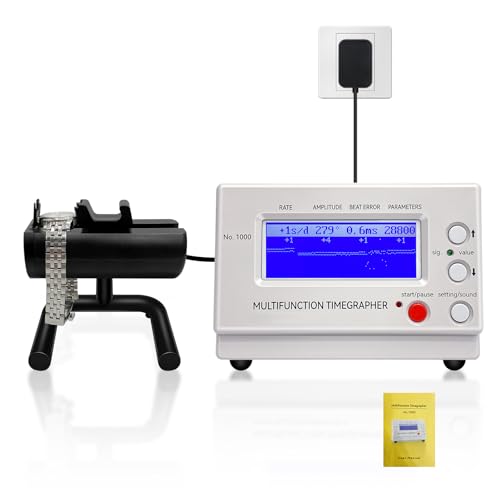
- Tests six key movement parameters
- 0.1-second-per-day rate resolution
- Supports adjustable sampling and positions
Best For: Technicians needing detailed mechanical-watch diagnostics
Best Beginner Value

- Focuses on core timing readings
- Graphical and numerical results
- Automatic signal-level adjustment
Best For: Beginners learning mechanical-watch accuracy testing
Precision Pick – SWANSOFT No.1000 Timegrapher
The SWANSOFT No.1000 is a feature-rich watch timing machine for diagnosing mechanical watch performance. It displays rate, amplitude, beat error, lift angle, and timing curves, with support for six testing positions and adjustable sampling cycles.
Best For: Watchmakers, technicians, and serious collectors who need detailed movement diagnostics and high stated accuracy.
Pros:
- Stated accuracy of ±0.1 seconds per day using a 50-sample average
- Measures rate, amplitude, beat error, and timing curves
- Supports six positions and adjustable lift angles from 30° to 70°
- Includes 12-month support
Cons:
- Designed for mechanical movements only, not quartz watches
- Its advanced settings may be more than casual users need
Choose this model if you want broad diagnostic information and fine adjustment options in one professional bench instrument. Its mechanical-only compatibility should be confirmed before purchase.
Coaxial Specialist – No.1900 LCD Timegrapher
OTOOLWORLD New Coaxial MTG Watch Tester Timing Multifunction Timegrapher LCD Screen NO.1900
Check Price On AmazonThe No.1900 is a practical watch timing machine with a larger LCD screen than the No.1000. It is designed for most mechanical watches, including coaxial models, and uses corded power with a 100V–240V range.
Best For: Watchmakers and collectors who want a larger display and coaxial-watch compatibility.
Pros:
- Larger LCD screen for easier viewing and operation
- Works with almost all mechanical watches and coaxial watches
- Includes exchangeable mini plugs for multiple regions
Cons:
- Supplied notes do not specify detailed accuracy or measurement ranges
- Requires corded electrical power
This is a sensible option when screen visibility and coaxial testing are priorities. Buyers seeking specific rate, amplitude, or beat-error specifications may want a model with those figures clearly listed.
Six-Position Value – MechanBINGOX Professional Timegrapher
The MechanBINGOX professional watch timing machine focuses on straightforward movement analysis. Its LCD shows rate, amplitude, beat error, and timing curves in real time, while six-position testing helps reveal consistency across orientations.
Best For: Collectors, repair shops, hobbyists, and enthusiasts who want essential mechanical-watch measurements and multi-position testing.
Pros:
- Real-time display of rate, amplitude, beat error, and timing curves
- Tests dial-up, dial-down, and four crown orientations
- Supports common frequencies from 18,000 to 36,000 BPH
- Designed for automatic and other mechanical watches
Cons:
- Not designed for quartz watches
- Supplied notes do not provide a specific accuracy figure
For users who want the core functions needed to monitor and regulate mechanical movements, this model offers a balanced feature set. Its frequency support should cover many common watches, but unusual movements may require verification.
Compact Classic – No.1000 Multifunction Timegrapher
The No.1000 is a compact watch timing machine for testing mechanical watches, including coaxial models. Its multifunction design makes it suitable for professional watchmakers and collectors who want a straightforward corded testing tool.
Best For: Users seeking a compact, general-purpose timegrapher for mechanical and coaxial watches.
Pros:
- Compatible with almost all mechanical watches, including coaxial models
- Compact dimensions of approximately 6.77 by 1.57 by 4.49 inches
- Designed as a multifunction tool for watchmakers and collectors
Cons:
- Compatible devices are limited to mechanical watches
- Supplied notes do not list detailed rate, amplitude, or beat-error ranges
- Requires corded electrical power
This model is a good fit when bench space and basic mechanical-watch compatibility matter most. Consider a more detailed instrument if you need published precision figures or extensive diagnostic controls.
Compact Quartz & Battery Tester – Multifunction Watch Timing Machine
If you need a compact watch timing machine for basic diagnostics, this battery-powered tester combines quartz movement testing, battery checks, pulse testing, and demagnetization in one small unit. Its adjustable demagnetization speed can be useful for routine watch-repair work.
Best For: Hobbyists and watch-repair workers who need portable quartz, battery, pulse, and demagnetization functions.
Pros:
- Combines quartz movement, battery, pulse, and demagnetizer functions.
- Adjustable demagnetization speed adds flexibility during use.
- Compact design weighs about 151 g.
Cons:
- Requires two 1.5V AA batteries, which are not included.
- Its supplied notes do not indicate detailed rate, amplitude, or beat-error readings.
This is a practical multi-function service tool rather than a dedicated mechanical timegrapher. Choose it when battery and quartz checks are as important as basic demagnetization support.
Large-Screen Mechanical Tester – Swansoft No.1900 Timegrapher
The Swansoft No.1900 is a dedicated watch timing machine for mechanical and automatic watches. Its larger, high-resolution color LCD displays rate, amplitude, beat error, beat, and lift angle, making it suited to calibration and performance checks at a watchmaking bench.
Best For: Watchmakers, technicians, collectors, and hobbyists evaluating mechanical watch performance.
Pros:
- Displays rate, amplitude, beat error, beat, and lift angle.
- Uses a larger, high-resolution color screen with backlighting.
- Includes a timegrapher sensor, US adapter, and professional manual.
- Designed for mechanical movement watches and backed by a one-year warranty.
Cons:
- Does not support quartz movement watches.
- Cord-powered and substantially heavier than a compact handheld tester.
With its readable display and focused mechanical-watch measurements, the No.1900 is the strongest choice here for bench-based timing analysis. It is less suitable if your work centers on quartz watches or portability.
Touch-Control Mechanical Tester – MTG-8000 Mechanical Timegrapher
Mechanical Watch Tester Timing Multifunction Timegrapher MTG-8000 touch button
Check Price On AmazonThe MTG-8000 is a mechanical watch timing machine with touch-button controls and a thinner, lighter design. Its coaxial test method is described as broadly applicable to mechanical watches, making it a versatile option for timing checks across a collection.
Best For: Mechanical-watch hobbyists and technicians seeking a slim, touch-controlled timegrapher.
Pros:
- Touch-button interface offers a modern control method.
- Thinner and lighter appearance than some traditional designs.
- Coaxial testing is described as applicable to essentially all mechanical watches.
Cons:
- Designed for mechanical watches, with no quartz testing noted.
- Supplied notes do not specify displayed measurements or included accessories.
The MTG-8000 is appealing when broad mechanical-watch compatibility and a lighter form factor matter most. Buyers who need confirmed measurements or package contents should verify those details before purchase.
Best Color-Screen Upgrade – TICFROG No. 1900 Timegrapher
If you want a watch timing machine with a clearer interface for troubleshooting, the TICFROG No. 1900 adds a high-resolution color display and separate traces for entrance and exit pings. It measures rate deviation, amplitude, and beat error while showing beat number and lift angle live.
Best For: Watch collectors, hobbyists, and professional or amateur watchmakers who want easier trace interpretation and support for mechanical and coaxial watches.
Pros:
- High-resolution color screen displays two traces in contrasting colors.
- Measures rate deviation, amplitude, and beat error, with live beat number and lift angle.
- Supports one to six measuring positions and 100V–240V AC power.
- Includes the sensor, US adapter, manual, and cleaning cloth.
Cons:
- It may offer more display capability than beginners need.
- The stated rate precision is 1.0 second per day.
The No. 1900 is the stronger choice when visual diagnosis matters. Its color traces can make adjustment work more intuitive than a monochrome display, while its broad measurement range keeps it useful for routine checks and repairs.
Best Measurement Detail – Professional No. 1000 Watch Tester
This watch timing machine is designed for detailed mechanical-watch diagnosis, combining daily rate, amplitude, polarity, beat, lift angle, and period measurements. Its acoustic sensing system, adjustable sampling period, and compact housing make it a practical bench tool for calibration work.
Best For: Technicians, makers, and serious enthusiasts who need broad measurement coverage and fine daily-rate resolution for mechanical watches.
Pros:
- Measures daily rate, beat amplitude, polarity, beat, lift angle, and period.
- Offers 0.1-second-per-day resolution and a daily-rate range of ±999 seconds per day.
- Supports two- to 60-second sampling periods and one to six directional measurements.
- Compact, portable design with 100V–240V ±10% input.
Cons:
- Its feature set may require more time to learn than a basic tester.
- The ABS housing is less substantial than a metal-bodied instrument.
Choose this model if measurement breadth and rate resolution are more important than a simplified feature set. It is particularly suited to users who want additional polarity and sampling controls during movement diagnosis.
Best Beginner Value – TICFROG No. 1000 Timegrapher
For newcomers learning how to evaluate mechanical watches, this watch timing machine focuses on the core readings: beat rate, beat error, and amplitude. It detects escapement sounds or vibrations and presents results numerically and graphically to help identify gains, losses, and irregularities.
Best For: Beginner watchmakers, collectors, and hobbyists who want an approachable tool for routine accuracy checks.
Pros:
- Concentrates on the essential rate, beat-error, and amplitude readings.
- Displays measurements both graphically and numerically.
- Includes automatic signal-level adjustment for simpler operation.
- Comes with a sensor, US adapter, manual, and cleaning cloth.
Cons:
- It does not provide the color-trace upgrade of the No. 1900.
- It is intended for essential analysis rather than the broadest diagnostic feature set.
The TICFROG No. 1000 is a sensible starting point when you need dependable core readings without moving immediately to a more advanced tester. Its straightforward presentation can help beginners understand a watch’s timing behavior before attempting adjustments.
How We Picked the Best Watch Timing Machine Options
We focused on the measurements most useful for mechanical-watch testing: daily rate, amplitude, beat error, and beat frequency. We also considered display readability, operating controls, microphone or sensor usability, lift-angle adjustment, portability, and the likelihood that a tool will be practical for repeated bench work.
Because listings and included accessories can vary, verify the exact specifications before ordering. A timegrapher is a diagnostic aid, not a replacement for proper cleaning, lubrication, inspection, or positional testing.
Quick Comparison
| Type | Best suited to | What to prioritize |
|---|---|---|
| No. 1000-style tester | Basic regulation and routine checks | Clear readings, stable pickup, adjustable lift angle |
| No. 1900-style tester | More frequent or professional bench use | Display quality, controls, repeatability, and build quality |
| MTG-style multifunction tester | Users wanting broader testing features | Supported frequencies, sensor performance, and included functions |
| Quartz or demagnetizing combination tool | Mixed watch-service tasks | Whether the extra functions are genuinely useful for your workload |
Key Buying Factors for a Watch Timing Machine
Measurements and Compatibility
Confirm that the machine supports the beat rates used by your watches and lets you enter or select the correct lift angle. Incorrect lift-angle settings can make amplitude readings misleading. For mechanical watches, rate, beat error, and amplitude are the core measurements.
Signal Pickup and Stability
A good tester should capture a consistent escapement signal without excessive noise. The clamp, microphone, or sensor should hold the watch securely while allowing you to test different positions. Stable readings matter more than a long list of extra modes.
Display and Controls
Look for a readable screen, straightforward controls, and a sampling period you can adjust. Touch controls may be convenient, while physical buttons can be easier to operate at a crowded workbench. Check power requirements and whether the package includes the necessary adapter.
Extra Functions
Demagnetizing and quartz-testing features can be useful, but combination devices may involve compromises. If your priority is regulating mechanical watches, favor measurement accuracy and usability over features you rarely need.
Who Should Buy Which Watch Timing Machine?
Choose a straightforward No. 1000-style tester if you are a hobbyist or need an affordable tool for occasional regulation. A No. 1900-style machine is a better fit for watchmakers who want a more polished display and expect frequent use. MTG-style models suit users who value multifunction operation and are prepared to confirm the technical specifications carefully.
If you service both mechanical and quartz watches, a combination unit with pulse testing or demagnetization may save bench space. For serious professional work, consider the tester’s repeatability, support, calibration process, and warranty—not only its advertised measurement range.