
Protecting passports, cash, jewelry, and important documents does not require a large, floor-standing safe. The best home safes for small spaces provide practical security while fitting inside a closet, cabinet, desk, or dorm room.
This roundup compares compact lock boxes and digital safes across storage capacity, access methods, portability, and fire or water protection so you can choose the right level of security for your space and budget.
Best 10 Home Safes for Small Spaces Picks for 2026
Best Overall
Amazon Basics 0.5-Cubic-Foot Electronic Safe

- 0.5-cubic-foot capacity with removable shelf
- Keypad access and two override keys
- Mounts to a wall, floor, or shelf
Best For: Apartments, offices, and general document storage
Best for Shared Spaces
Compact 0.3-Cubic-Foot Safe with Alarm

- Compact footprint for apartments and dorms
- Alarm after repeated wrong passwords
- Keypad, key, and backup-power access
Best For: Roommates, dorms, and shared homes
Best Compact Fit
Bonsaii 0.23-Cubic-Foot USB-C Safe

- Smallest footprint in the roundup
- USB-C external backup-power support
- Mounts under furniture or inside cabinets
Best For: Small valuables in dorms, bedrooms, and compact offices
Best Features
Mitlvge 0.9-Cubic-Foot Safe with Shelf

- Largest listed capacity with removable shelf
- Includes fireproof waterproof document bag
- Sensor light, alarm, and silent mode
Best For: Organized storage of documents and multiple valuables
Versatile Steel Security

- 0.6-cubic-foot interior with removable shelf
- Wall, floor, or cabinet mounting
- Keypad entry with two override keys
Best For: Compact bedside, closet, office, or cabinet storage
Fire-Ready Hidden Storage

- 0.5-cubic-foot compact footprint
- Designed for 35 minutes of fire protection at 1800°F
- Keypad, backup keys, alarm, and interior LED
Best For: Apartments, bedrooms, offices, and hidden document storage
Portable Personal Security

- Portable design for travel or discreet storage
- Anti-pry steel body with padded interior
- Combination lock needs no batteries
Best For: Dorm rooms, travel, and smaller personal valuables
Smart Access Pick

- Four access methods, including fingerprint and app control
- 0.78-cu.-ft. capacity with removable shelf
- LED lighting, silent mode, and emergency power port
Best For: Bedrooms, wardrobes, and home offices needing flexible access
Most Portable
SentrySafe P005C Compact Lock Box

- Tiny 0.05-cu.-ft. steel lock box
- Resettable three-digit combination
- Tethering cable helps secure it to a fixed object
Best For: Dorms, offices, travel, and small everyday valuables
Balanced Compact Safe
Yuanshikj Digital Security Safe
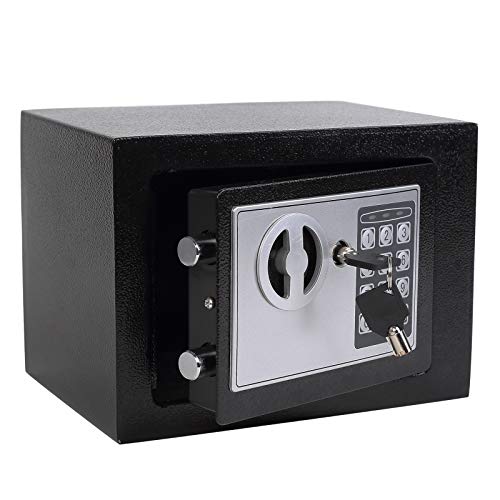
- 0.23-cu.-ft. capacity in a compact steel body
- Keypad access plus two emergency keys
- Pre-drilled holes for wall or floor mounting
Best For: Bedrooms, apartments, dorms, and modest household storage
Best Overall – Amazon Basics 0.5-Cubic-Foot Electronic Safe
For shoppers comparing home safes for small spaces, this Amazon Basics model offers a practical balance of capacity, mounting flexibility, and everyday electronic access. Its 0.5-cubic-foot interior includes a removable shelf, while the steel construction and concealed hinges add basic physical security.
Best For: Apartments, home offices, and buyers who want more room than a compact lock box provides.
Pros:
- 0.5-cubic-foot capacity with an adjustable, removable shelf
- Electronic keypad plus two emergency override keys
- Pre-drilled holes and included expansion bolts support wall, floor, or shelf mounting
- Carpeted floor helps protect stored items from scratches
Cons:
- AA batteries are not included
- Not water resistant
- Heavier and larger than the smallest options in this roundup
This is a versatile choice when you need useful interior space without moving up to a full-size safe. Plan its placement carefully, since the 18.26-pound body is best secured through its mounting points.
Best for Shared Spaces – Compact 0.3-Cubic-Foot Safe with Alarm
This compact safe is designed for tight apartments, dorm rooms, closets, shelves, and drawers. Among home safes for small spaces, it stands out for its wrong-password alarm, three unlocking methods, and included fireproof bag—although the safe itself is explicitly not fireproof.
Best For: Shared living situations where an audible access alert and discreet mute mode are useful.
Pros:
- Compact 0.3-cubic-foot footprint for small rooms and concealed placement
- Three access options: keypad, emergency key, and external backup power
- Wrong-password attempts trigger a 60-second alarm, with mute mode available
- Includes mounting hardware and a fireproof bag for documents
Cons:
- The safe itself is not fireproof
- Smaller capacity than the 0.5- and 0.9-cubic-foot models
- Alarm may be unsuitable where quiet operation is always required
Its compact dimensions and alert system make it especially practical for roommates, guests, or occasional maintenance access. Use the included bag for added document protection, but do not treat the steel safe as fire protection.
Best Compact Fit – Bonsaii 0.23-Cubic-Foot USB-C Safe
When floor and shelf space are especially limited, the Bonsaii safe offers one of the smallest footprints among these home safes for small spaces. It combines electronic access with an emergency key, USB-C external power support, and mounting holes for installation under a closet, drawer, or table.
Best For: Small valuables such as cash, jewelry, and documents in bedrooms, dorms, or compact workspaces.
Pros:
- Small 0.23-cubic-foot design fits closets, shelves, and drawers
- USB-C interface can accept power from an external power bank when batteries deplete
- SPHC steel body, concealed hinges, and two reinforcement bolts
- Pre-drilled back and bottom holes support wall or floor installation
Cons:
- Power bank and batteries are not included
- Smallest listed capacity, limiting larger documents or collections
- Requires keeping the emergency key outside the safe for backup access
This model prioritizes concealability and convenient backup power over storage volume. It is a strong fit for essential valuables, provided you verify the interior dimensions before storing bulky items.
Best Features – Mitlvge 0.9-Cubic-Foot Safe with Shelf
The Mitlvge provides the most listed capacity here while retaining a compact 9.85-inch height. For buyers seeking home safes for small spaces with extra organization and added fire-document protection, it includes a removable shelf, interior sensor light, alarm controls, and a separate fireproof waterproof document bag.
Best For: Households that need more organized storage for documents, electronics, medicine, or other valuables.
Pros:
- 0.9-cubic-foot capacity with a removable shelf
- 50 mm steel door, three solid locking bolts, and concealed pry-resistant hinges
- Includes an A5 fireproof waterproof document bag
- Sensor light, programmable keypad, emergency keys, and silent mode
Cons:
- Larger footprint than the two ultra-compact safes
- The included fireproof bag provides document protection; the safe itself should not be assumed fireproof
- Additional features may be more than needed for simple cash storage
This is the feature-rich option for buyers who can accommodate a roughly 14-by-10-inch exterior. Its shelf and interior light improve usability, while wall or floor mounting can help reduce the risk of removal.
Versatile Steel Security – Compact Digital Safe
If you need home safes for small spaces, the Locksworth safe offers flexible storage in a compact footprint. Its 0.6-cubic-foot interior includes a removable shelf, making room for documents, cash, jewelry, or a handgun while fitting beside a bed, in a closet, or under a counter.
Best For: Households wanting a compact, mountable safe with keypad and key access.
Pros:
- Removable shelf helps organize the 0.6-cubic-foot interior.
- Steel construction, a pry-resistant door, and reinforced frame add physical security.
- Supports wall, floor, or cabinet mounting with included expansion bolts.
- Offers personal-code entry plus two override keys.
Cons:
- Its compact capacity may not suit bulky valuables.
- Electronic access requires batteries, although backup keys are included.
With its flexible installation options and dual-access design, this is a practical choice when you want organized security without giving up much room.
Fire-Ready Hidden Storage – Small Fireproof Safe
For shoppers comparing home safes for small spaces, this 0.5-cubic-foot model emphasizes fire protection as well as security. Its compact dimensions suit drawers, cabinets, closets, nightstands, apartments, and offices, while the fire-resistant construction is designed to protect contents for up to 35 minutes at temperatures up to 1800°F.
Best For: Small-space storage of documents and valuables where fire protection is a priority.
Pros:
- Compact design fits hidden locations such as drawers, closets, and cabinets.
- Three-layer construction is designed for up to 35 minutes of fire protection at 1800°F.
- Includes digital keypad access, emergency keys, an exterior battery compartment, and an alarm.
- Interior LED light improves visibility when the door opens.
Cons:
- Its 0.5-cubic-foot capacity is better suited to everyday valuables than large collections.
- Mounting requires removing the factory-installed plugs before using the included expansion bolts.
This safe stands out for combining a relatively small footprint with fire-focused construction, optional mounting, and helpful access features for daily use.
Portable Personal Security – Combination Lock Case
If your idea of home safes for small spaces includes something portable, the Amazon Basics security case is easy to store discreetly and carry when needed. Its compact case has an anti-pry steel body, foam-padded interior, and combination lock for documents, cash, jewelry, personal items, or firearms.
Best For: Dorm rooms, travel, and portable storage of smaller valuables or personal items.
Pros:
- Compact, portable design is convenient for discreet storage and travel.
- Anti-pry steel construction provides a physical barrier for valuables.
- Foam-padded interior helps cushion stored items.
- Combination lock avoids the need for batteries or keys.
Cons:
- It has no alarm, water resistance, or mounting option.
- The 110-cubic-inch capacity is limited compared with full-size home safes.
- It is not designed as a fireproof safe.
This case is best viewed as a lightweight, portable security solution rather than a fixed safe—particularly useful when discreet storage and easy transport matter most.
Smart Access Pick – XDeer Biometric Safe
For shoppers comparing home safes for small spaces, the XDeer combines a relatively compact footprint with several access methods and app connectivity. Its 0.78-cubic-foot interior includes a removable shelf, while LED lighting and silent mode support discreet access.
Best For: Small bedrooms, wardrobes, or home offices where biometric and smartphone access are useful.
Pros:
- Supports fingerprint, backlit keypad, keys, and app access.
- Bluetooth/Wi-Fi app features include temporary codes, access logs, and battery monitoring.
- Removable shelf helps organize cash, jewelry, and documents.
- Includes mounting hardware and an emergency power port.
Cons:
- Larger and less portable than compact lock boxes.
- App-connected features may be more than some users need.
Choose this model when convenient, flexible access matters more than having the smallest possible safe. Its 9.69-by-13.62-by-9.69-inch size should be measured against the intended shelf, wardrobe, or floor location before buying.
Most Portable – SentrySafe P005C Compact Lock Box
The SentrySafe P005C is a particularly compact option for home safes for small spaces. Its 0.05-cubic-foot steel lock box is sized for essentials such as cash, keys, credit cards, and USB drives, and it can be secured to a fixed object with the included tethering cable.
Best For: Dorm rooms, offices, travel, coffee shops, or anyone protecting a small set of everyday items.
Pros:
- Very small 2.6-by-5.9-by-8-inch exterior footprint.
- Solid-steel construction provides a durable enclosure.
- Resettable three-digit combination avoids the need for a key.
- Tethering cable supports securing the box to a fixed object.
Cons:
- 0.05-cubic-foot capacity is limited to compact valuables.
- Combination lock offers fewer access features than electronic or biometric models.
This is a practical pick when portability and minimal size are the priorities. Its compact interior is not intended for bulky documents or larger valuables, so check the listed interior dimensions before ordering.
Balanced Compact Safe – Yuanshikj Digital Security Safe
The Yuanshikj offers a middle ground for home safes for small spaces, with more room than a portable lock box but a smaller footprint than many full-size home safes. It uses a programmable keypad, includes two emergency keys, and has pre-drilled holes for wall or floor mounting.
Best For: Bedrooms, dorms, apartments, hotels, or offices storing cash, jewelry, and other modest-sized valuables.
Pros:
- 0.23-cubic-foot capacity balances storage and compact placement.
- Digital keypad and two emergency keys provide access flexibility.
- Reinforced steel construction uses dual steel door-locking bolts.
- Pre-drilled mounting holes and included expansion screws support installation.
Cons:
- Not water resistant according to the supplied specifications.
- Interior dimensions should be checked carefully because the safe is still compact.
- Requires batteries for normal electronic keypad operation.
This model suits buyers who want a conventional steel safe with keypad convenience and backup keys. Measure the installation area and intended contents carefully, especially when placing it inside furniture or a narrow closet.
How We Picked the Best Home Safes for Small Spaces
We focused on compact safes that are practical for apartments, bedrooms, offices, dorm rooms, and other areas where floor space is limited. The selection includes keyed, combination, electronic keypad, and biometric models, along with portable lock boxes and options offering fire-resistant protection.
We compared stated capacity, exterior footprint, construction, access features, interior organization, portability, and installation considerations. Because security claims vary by manufacturer, treat fire and water ratings as product-specific features rather than assuming every safe protects against every hazard.
A compact safe is most useful when it can be secured properly. Models with mounting holes or anchoring hardware may offer more theft resistance than a portable case, while portable designs can be convenient for travel or shared living spaces.
Quick Comparison
- Best all-around compact storage: Look for a steel safe with a digital keypad and enough room for documents, cash, and small valuables.
- Best for easy access: Electronic or biometric models reduce the need to manage a physical key, although they require batteries and backup-entry planning.
- Best for portability: Combination lock boxes and lightweight cases work well in dorms, offices, and temporary living arrangements.
- Best for larger collections: A 0.6- to 0.78-cubic-foot model provides more flexibility for jewelry, documents, and small electronics.
- Best for emergency protection: Fireproof models may be preferable for irreplaceable papers, but check the exact fire rating, duration, and water-resistance claims.
Key Buying Factors for Home Safes for Small Spaces
Size and Usable Capacity
Measure the intended shelf, drawer, or cabinet before ordering. Exterior dimensions determine whether the safe fits, while interior capacity determines whether it can hold folders, passports, envelopes, and personal items. Shelves can improve organization but may reduce space for larger objects.
Lock Type and Backup Entry
Keypad safes are convenient for frequent access, while combination locks avoid batteries. Biometric entry can be fast, but fingerprints may not always register reliably. Check whether the safe includes override keys, emergency power access, or a reset procedure.
Construction and Installation
Steel walls, concealed hinges, locking bolts, and pry-resistant doors can improve basic security. If theft is the primary concern, prioritize a model that can be anchored to a solid surface. A heavy safe is not automatically secure, especially if it can be carried away.
Fire and Water Protection
For birth certificates, deeds, and other irreplaceable documents, review the stated fire temperature and protection time. Confirm what materials are covered and whether the product has a verified water-resistance rating. Do not assume a standard steel security safe is fireproof.
Who Should Buy Which Home Safes for Small Spaces?
Choose a compact keypad safe if you want quick everyday access to cash, jewelry, medications, or documents. Choose a portable combination case for dorm rooms, travel, or situations where you cannot permanently install a safe. Choose a larger digital or biometric model if you need room for multiple categories of valuables and prefer flexible access. Choose a fire-rated safe when document protection is more important than minimal size.
Before buying, confirm the dimensions, battery requirements, included keys or mounting hardware, warranty, and return policy. The right safe should fit your available space, match your access habits, and provide protection appropriate to the risks you are trying to manage.